



In this blog post, I am going to discuss OSPF LSA retransmission pacing, an OSPF technique related to network convergence and scalability. Particularly, I am going to explain how LSA retransmission pacing helps prevent CPU bursts and high bandwidth utilization.
Note that OSPF supports other features that enhance network convergence such as OSPF LSA flood pacing, OSPF LSA group pacing, OSPF LSA throttling, OSPF SPF throttling, and OSPF incremental SPF.
In this post, I will be using this network topology. The OSPF router ID values of routers R1, R2, R3, and R4 are 1.1.1.1, 2.2.2.2, 3.3.3.3, and 4.4.4.4, respectively.

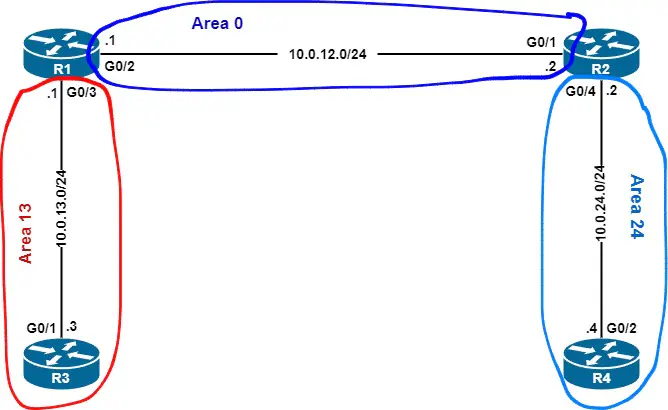
Here are the initial router configurations.
| Router R1 | Router R2 | Router R3 | Router R4 |
How Does OSPF LSA Retransmission Work?
LSA (Link State Advertisement) is an OSPF data structure type containing information about a network link’s state. When a router receives an LSA, it stores it in its link state database (LSDB) and then floods it out to all OSPF adjacent neighbors.
OSPF uses the flooding procedure to propagate and synchronize the link-state database (LSDB) between OSPF neighbors.
OSPF requires that LSAs, eligible to be sent to an OSPF neighbor, get retransmitted until the router receives acknowledgements for them. This way OSPF ensures that the LSA flooding procedure is reliable.
LSA retransmission refers to the process by which a router retransmits an LSA to its neighboring routers if it does not receive an acknowledgment that the LSA was received. This is done to guarantee that all routers in the network have the most current data about the state of the network links.
OSPF places eligible LSAs for reflooding to an OSFP neighbor on the neighbor’s Link state retransmission list. Multiple LSAs can be retransmitted using one single Link State Update packet.
The LS retransmission list is the collection of LSAs that have been sent to an OSPF adjacent neighbor, but for which the router has not yet received LS acknowledgments.
OSPF sends all LSAs in that list at once at preset times, specifically each time the retransmission timer is triggered, until they are acknowledged or until the corresponding OSPF adjacency with that neighbor is dropped.
The amount of time between two consecutive LSA retransmissions is RxmtInterval, the retransmission timer’s value, which is configured on a per-interface basis using the ip ospf retransmit-interval command.
If the retransmission timer is too small, the router will resend the same LSA several times before it is acknowledged by the neighbor. This results in a high number of LSA dispatches per acknowledgement, leading to unnecessary LSA retransmissions.
What is OSPF LSA Retransmission Pacing and How Does OSPF LSA Retransmission Pacing Work?
OSPF LSA retransmission pacing is a technique implemented in Cisco IOS to control the rate at which OSPF retransmits a subset of the LSAs in a neighbor’s retransmission list, regardless of whether the LSAs are self-originated or not. LSA retransmission pacing affects all OSPF LSA types.


Figure 1 – Sending all LSAs in the retransmission list at once
LSA retransmission pacing guarantees that LSAs in a neighbor’s retransmission list are not flooded at once. Sending all those LSAs together, especially when the routing domain is huge, would cause sudden CPU spikes and high bandwidth utilization (Figure 1).
By implementing this feature, OSPF sends a portion of the LSAs in the retransmission list of a particular neighbor on each firing of the LSA retransmission pacing timer (Figure 2).


Figure 2 – Sending LSAs in the retransmission list per groups
Overall, LSA retransmission pacing reduces the network bandwidth and CPU cycles used by OSPF neighbors when exchanging unacknowledged LSAs between them.
OSPF LSA Retransmission Pacing Timer
The LSA retransmission pacing timer is an automatic mechanism used to resend a subset of the LSAs in an OSPF neighbor’s retransmission list at preset times. By default, the LSA retransmission pacing timer is 66 milliseconds.
Optimizing and reducing the volume of LSAs exchanged between OSPF adjacent neighbors can be achieved in various manners such as OSPF summarization, which helps decrease the number of LSAs exchanged between OSPF areas and the number of external LSAs advertised through the OSPF routing domain.
Additionally, using OSPF stub area types on one or many areas would maintain the size of LSDBs reduced, and thus routers use less CPU cycles and bandwidth during the LSA flooding process.
Finally, keep in mind that adjusting the LSA retransmission pacing timer to optimize exchanging unacknowledged LSA is not recommended and should be a last resort.
However, because each OSPF routing domain is unique, changing this timer may be a good option since it is easy to configure, unlike configuring OSPF summarization and stub areas.
OSPF LSA Retransmission Pacing Configuration and Verification on Cisco IOS
On Cisco IOS 12.2(4)T and above, the default OSPF LSA retransmission pacing timer is 66 milliseconds. To adjust this timer, use the timers pacing retransmission drtn command in router configuration mode, where drtn is a number between 5 milliseconds to 200 milliseconds.
This example sets the OSPF LSA retransmission packet pacing timer to 20 milliseconds on router R2.
R2(config)# router ospf 1
R2(config-router)# timers pacing retransmission 20
To verify the LSA retransmission pacing timer, use the show ip ospf command in enable mode, as shown in this example.
R2# show ip ospf
Routing Process "ospf 1" with ID 2.2.2.2
Start time: 00:06:16.186, Time elapsed: 02:20:29.731
Supports only single TOS(TOS0) routes
Supports opaque LSA
Supports Link-local Signaling (LLS)
Supports area transit capability
Supports NSSA (compatible with RFC 3101)
Supports Database Exchange Summary List Optimization (RFC 5243)
Event-log enabled, Maximum number of events: 1000, Mode: cyclic
It is an area border router
Router is not originating router-LSAs with maximum metric
Initial SPF schedule delay 5000 msecs
Minimum hold time between two consecutive SPFs 10000 msecs
Maximum wait time between two consecutive SPFs 10000 msecs
Incremental-SPF disabled
Minimum LSA interval 5 secs
Minimum LSA arrival 1000 msecs
LSA group pacing timer 100 secs
Interface flood pacing timer 33 msecs
Retransmission pacing timer 20 msecs


omitted output
